Acupressure Mats: A Thin Evidence Base and a Wide Price Range
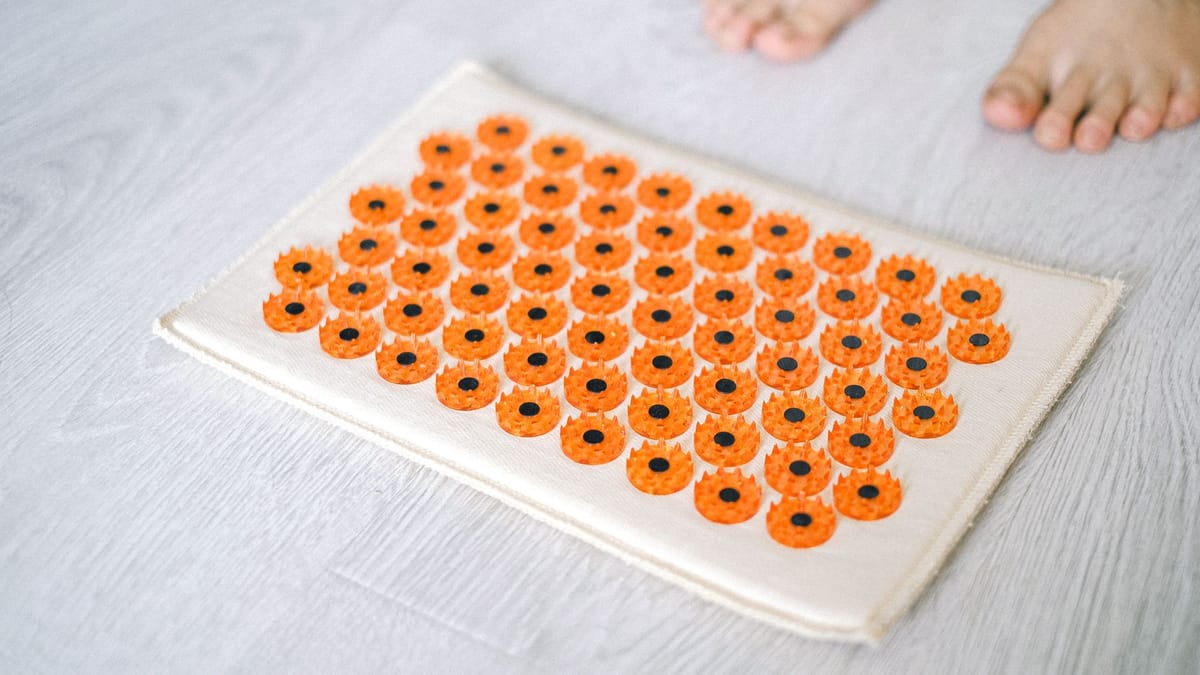
Acupressure mats are foam pads studded with plastic discs bearing sharp points, sold on claims about pain relief, circulation and sleep. Prices run from under £30 to well over £200 for products that differ mainly in materials and construction quality. The category deserves a careful look because the claims are medical in flavour while the research behind them is unusually thin. This guide covers what has actually been measured, what separates the established brands, and how to approach a purchase without expecting more than the evidence supports.
Where the research currently stands
- The most cited mat-specific trial enrolled 44 participants across two groups
- That study used no sham control, which its own authors list as a limitation
- A 2021 meta-analysis of acupressure covered 23 randomised trials and 2,400 participants, but studied manual acupressure rather than mats
- That meta-analysis reported GRADE downgrades on the trials it reviewed and called for further investigation
- Adherence in the mat trial was self-reported rather than objectively monitored
Why a brand you cannot verify is a brand to skip
Mats in this category are frequently sold under names that appear on marketplaces for a season and then vanish, with the same product photography reused across several listings. An example is the Iris acupressure mat, which turns up as an IRIS-branded mat and pillow set on Amazon.in and Flipkart, sold into the Indian market by a general fitness accessories brand. There is no manufacturer specification sheet, no independent testing and no international distribution behind it.
That does not mean the product is bad. It means there is nothing to review. Without a stated point count, a materials declaration, a warranty and some record of third-party testing, any assessment would be guesswork dressed up as analysis. The brands named further down all publish those details.
What the mat trial actually found
The most directly relevant study is a prospective, randomised, single-blinded trial published in Applied Sciences examining an acupressure mat alongside therapeutic exercise for chronic low back pain. It enrolled 44 patients, 31 female and 13 male, split evenly between an experimental and a control group, with four weeks of supervised rehabilitation followed by six months of home-based follow-up. Pain intensity on a visual analogue scale was the primary outcome, with the McGill Pain Questionnaire, the Oswestry Disability Index and EuroQol-5D as secondary measures.
Both groups improved significantly over time, which is what usually happens when people with back pain do supervised exercise. The mat group showed a significant time interaction on the visual analogue scale that the control group did not, which the authors read as suggesting additional benefit at medium and long-term follow-up. That is a modest, plausible finding from a small sample, and it is the strongest single piece of evidence the category has.
The sham control problem, and why it bites harder here
The study’s authors list several limitations candidly: a small sample, a short follow-up period, reliance on patient self-reporting for mat and exercise adherence, and the absence of a sham acupressure control, which they acknowledge limits any assessment of placebo effect.
That last omission is more damaging for a mat than for most interventions. Lying on a spiked surface produces an immediate, unmistakable and fairly intense sensation. It is impossible to blind a participant to whether they are receiving it, and the sensation itself is exactly the kind of strong sensory input that generates large placebo and counter-irritation responses. A 2021 systematic review and meta-analysis of acupressure for low back pain, covering 23 trials and 2,400 participants, reported effects favouring acupressure over usual care but explicitly downgraded the evidence under GRADE assessment, concluding that further investigation was needed to confirm the observations. Garage Gym Reviews likewise notes a 2023 study that found no significant difference between mat users and students practising other relaxation techniques.
The reasonable conclusion is that people frequently report feeling better after using one, that this is a real experience, and that the mechanism is not established.
The brands with a track record, and what separates them
- Pranamat ECO: at the top of the price range, listed by Garage Gym Reviews at 285 US dollars for the classic massage set, using natural linen and coconut fibre with OEKO-TEX certification. Criticised there as expensive, sharp on first use and offering no adjustable intensity.
- ProsourceFit: the budget option at 29.99 US dollars, with 6,210 points on the half-body mat, 11,178 on the full-body version and 1,782 on the pillow, sold in eleven colours with a lifetime warranty. Downsides noted include hand-wash-only care, an internal insert that can shift and spikes some find too intense.
- Shakti: a long-established name carrying a five-year warranty, though Garage Gym Reviews states plainly that its team has not tested it, so treat comparative claims about it with caution.
- Bed of Nails: another established brand in the category, but one that comparison testing covers less consistently than the others, so specifications should be taken from the manufacturer rather than aggregator sites.
Circumstances in which one is a bad idea
- Anyone taking anticoagulants or with a bleeding disorder, because the points break skin under some body weights
- People with diabetic neuropathy or any condition causing reduced sensation, since the usual pain feedback that limits exposure is absent
- Skin that is broken, inflamed, sunburnt or affected by an active condition in the contact area
- During pregnancy, where the sensible course is to ask a midwife or GP first rather than rely on manufacturer guidance
- Anyone using one as a substitute for investigating new, severe or worsening back pain rather than as an addition to it
A sensible way to start
- Begin with a shirt between skin and points, which most manufacturers recommend and which makes the first sessions tolerable
- Limit early sessions to five to ten minutes rather than the twenty-plus that instructions often suggest
- Use it lying flat on a firm surface, since a soft mattress reduces the pressure the mat is meant to apply
- Expect redness and a strong burning sensation for the first few minutes; expect it to fade, and stop if it does not
- Give it a fortnight before judging, and be honest about whether the benefit is from the mat or from twenty minutes of lying still
Sources: Applied Sciences, randomised controlled study of an acupressure mat in chronic low back pain · PubMed, systematic review and meta-analysis of acupressure for low back pain · Garage Gym Reviews, best acupressure mats tested · ScienceDirect, efficacy of acupressure for chronic low back pain systematic review