What the Range Name on a Clarks Box Is Telling You
Two pairs of Clarks can be different enough that they might as well come from separate companies.
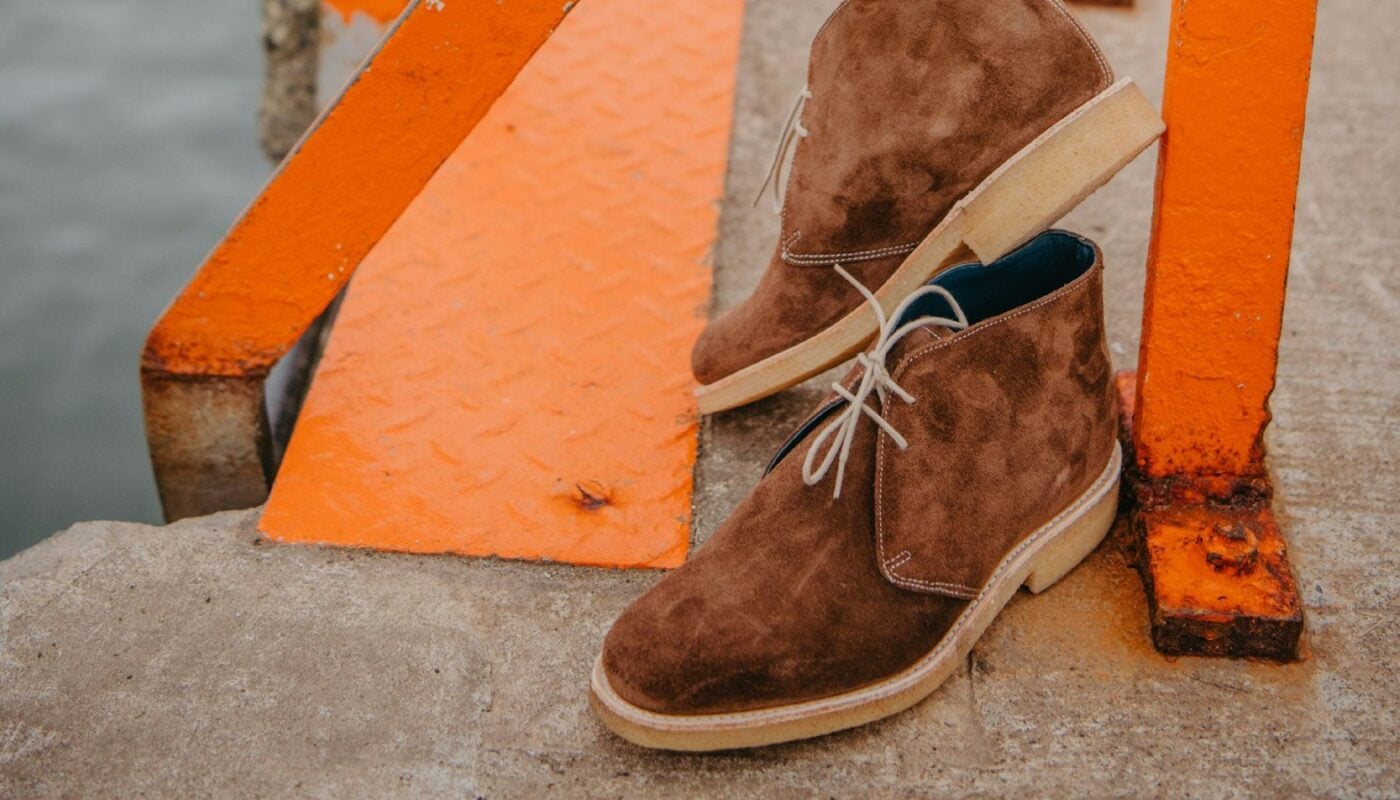
One is a suede boot on a pale crepe sole, the same shape it has been since 1950, with very little cushioning in it. The other is a polished leather lace-up built around a dual-layer foam midsole and sold on the promise that your feet will not be complaining by six in the evening. Same name on the box, entirely different brief.
That is the useful thing about how Clarks sorts its shoes. The range name is printed on the label, and it tells you which problem the shoe was designed to solve. Read that first and the rest of the choice gets much simpler.
One name, five separate design briefs
Clarks has been running these programmes in parallel for years, and they have almost nothing in common beyond the logo:
- Originals — the heritage shapes, on crepe soles
- Cloudsteppers — the soft, light, heavily cushioned end
- Clarks Code — leather shoes engineered around impact absorption
- Clarks Pace — walking shoes, designed and tested as walking shoes
- Wide and extra wide fittings — cutting across all of the above
Pick the range that matches how you spend your day and you are most of the way to the right shoe already. Pick a style because you liked the look of it and you can end up with a beautiful boot that was never built for eight hours on concrete.
👟 Find the range that matches your week
Originals: bought for the shape, and the shape has not moved
This is the part of Clarks that people collect. The brand dates the Desert Boot precisely: “Designed by Nathan Clark in 1950, the Desert Boot revolutionized casual footwear with its clean lines and crepe sole, becoming a global icon.” The Wallabee follows — “Introduced in 1968, the Clarks Wallabee redefined casual style with its moccasin-inspired shape and clean silhouette” — and the Desert Trek arrives in 1972, designed by Lance Clark, with its central seam and what Clarks calls a “foot-shaped fit”.
Three shoes, three decades, still in production in their original silhouettes. That is rare, and it is most of the appeal. An Originals pair does not date, because it has already spent seventy years not dating.
What you are buying is the shape and the crepe sole. Crepe is soft underfoot, quiet, grippy on dry ground, and it moulds to your foot over a few weeks of wear. It was never meant to be a performance sole. If your reason for buying is that the shoe looks right with almost everything you own, Originals is the range that delivers it, and the one that holds its look longest.
Cloudsteppers: the softest thing Clarks makes
Cloudsteppers runs on the opposite instinct. Clarks describes it as “Layers of plush cushioning and clever comfort tech” that “unite to create ultra-comfortable sandals and slip-ons”, and the line is built around two named footbeds: PillowSoft™, which the brand says gives “a cushioned, cloud-like feel with every step”, and CushionSoft™, described as “Supreme softness” with “Supportive foam”.
The Solevana styles sit at the top of it, on a Solevana foam™ outsole Clarks calls “our most elevated cushioning yet”. Solevana Lace is the bestseller, Solevana Sport the newer men’s version, with Breeze Rose and Step 365 Lace covering the everyday end and the Breeze collection handling sandals and flip-flops.
These are the pairs for days with a lot of standing and no dress code — school runs, markets, airports, most of the summer. They are light, they go on without ceremony, and they sit below the leather ranges on price.
Code: a leather shoe built around the foam, not the other way round
Clarks Code looks formal and is engineered like a trainer underneath. It runs on C360 Foam, which Clarks describes as “shock-absorbing foam that reduces foot fatigue”, delivering “360° Impact Absorption” from a “dual-layer cushioning system that absorbs impact and returns energy with every step”, for “all-day comfort for on-the-move days”.
The line is broad enough to cover most offices. Code Tie and Code Lace do the traditional lace-up. Code Court and Code Edge are cleaner and less formal. Code Hybrid Plain and Code Hybrid Vibe let the sole look athletic, and Code Run and Code Step sit at the sportiest end of it.
If your job keeps you on your feet in shoes that still have to look smart, this range was built for that specific problem, and it is where the money goes furthest.
Pace: designed for walking, and judged as a walking shoe
The Pace collection opens with a line that explains the whole range: “walking is different than running, your shoes should be too.” Clarks calls it “the ultimate walking shoe”, designed “to support natural movement and all-day wear” for “walking, travel, and busy, on-the-go lifestyles.”
Underneath there is a guided design that Clarks says “helps align and support your natural stride”, a molded footbed for “cushioned comfort and reliable support”, and the Clarks C-Tread™ outsole for “dependable traction across a variety of surfaces”.
Two things lift that above brand copy. The shoes are APMA approved, which is an outside podiatric body putting its name to them, and the collection took the 2026 Women’s Health Sneaker Award for comfort, performance and all-day wear in walking shoes. Named styles run from Pace Walk and Pace Rise up to Pace Trail Go Waterproof and the waterproof Pace Trail boots.
For travel, and for long days on your feet in daylight, this is the range to look at before any of the others.

Wide and extra wide are on the shelf, not a special order
This is the quiet reason people stay with Clarks for decades.
There are dedicated wide-fit ranges for both men and women, and the men’s side goes further into extra wide. Clarks is direct about the point of it: “With our selection of wide-fit shoes, you’ll never have to forego style or comfort.” The men’s section also lists “Extended Sizes & Widths”, and the kids’ range is sized in three separate bands — toddler 0 to 10, little kid 10.5 to 3, big kid 3.5 to 7.
Plenty of brands publish one width and leave your foot to negotiate. If standard sizing has never quite worked for you, set the width filter before you look at a single style. It changes which shoes are available to you far more than the range does.
🦶 Check which styles come in wide and extra wide
Where each range stops working
The edges are easy enough to see. Originals has very little cushioning under it, so a Desert Boot is the wrong tool for a twelve-hour shift. Cloudsteppers is soft rather than structured, which makes it a poor match for a strict dress code. Code is leather, so it wants the care any leather shoe wants. Pace is built for walking specifically, which is the whole point, and it does not pretend to be a running shoe.
None of that counts as a fault. It is what happens when five ranges are each designed for one job, instead of one shoe being asked to do all five.
The ranges worth paying full price for
Two of them, for the same underlying reason.
Originals holds its value because the design does not move. A Desert Boot bought this year looks like one bought a decade ago, so the cost per wear keeps falling for as long as you keep wearing it. Paying full price for a shape that has outlasted seventy years of fashion is a fair trade.
Code is the other, on different grounds. If you are standing in those shoes all day, the C360 midsole is the thing you are actually buying, and it is not something an insole adds afterwards.
The rest rewards a little patience. Cloudsteppers styles rotate with the season, Pace colourways change, and both ranges are deep enough that something in them is usually reduced. Set the width first, choose the range second, then look at what has been marked down inside it. That order gets you a shoe built for the way you actually live, at whatever price the range happens to be that week.
🛒 See what is marked down across the ranges