Rode’s Wireless ME Has Become the Odd One Out in Its Own Range
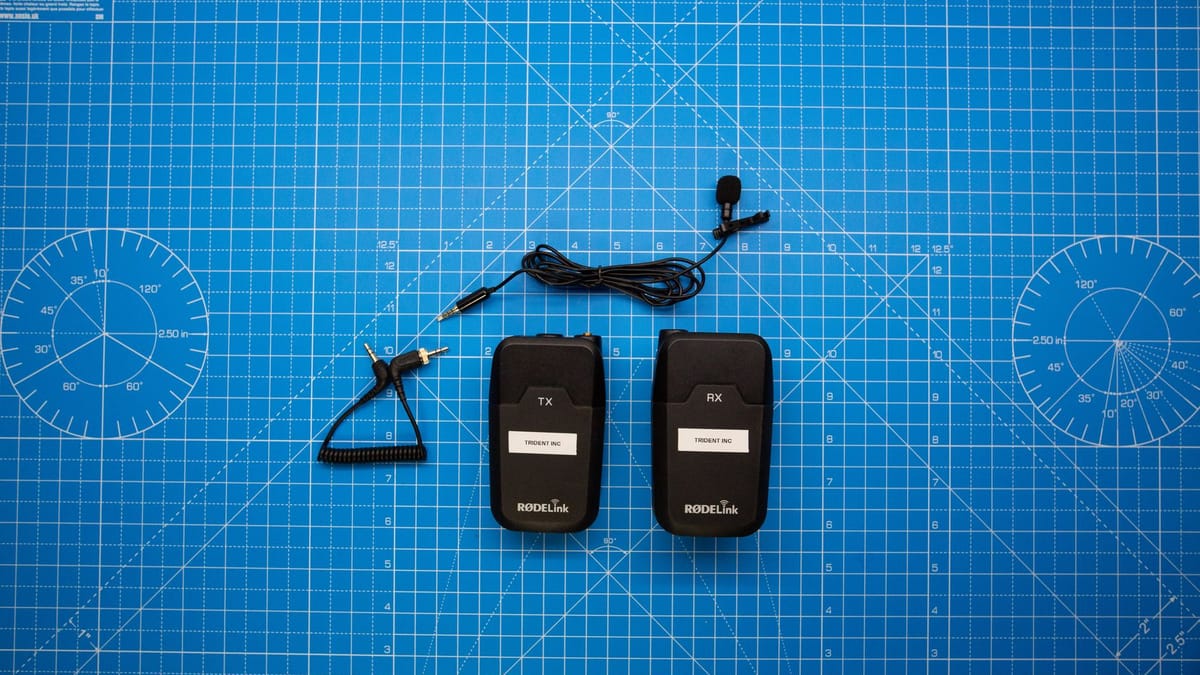
The Wireless ME was Rode’s answer to a specific problem: a two-piece radio microphone simple enough that a single operator could clip it on and start recording without a gain check. It solved that with a microphone built into the receiver as well as the transmitter, which no competitor has copied. Since then Rode has released the Wireless Micro and the Wireless GO Gen 3, and in September 2025 cut prices across the range. The ME now sits in an awkward position, and understanding it means understanding what surrounds it.
The receiver microphone is the thing nobody else did
Rode’s specification confirms omnidirectional microphones built into both the transmitter and the receiver. In practice this means a two-person interview can be captured with a single transmitter clipped to the subject while the receiver, mounted on the camera, picks up the person asking the questions. The result is not a clean two-channel recording, but it is a usable one, and it removes an entire piece of kit from the bag.
The other half of the design is GainAssist, Rode’s automatic level control, which the company describes as controlling audio levels for clear sound without operator input. It is genuinely effective at preventing clipping on unpredictable subjects. It is also not defeatable in the way a professional would want, which is the design trade-off the whole product is built around: the ME assumes the operator would rather have a safe recording than a perfect one.
Where the ME sits after Rode redrew its price list
- Wireless Micro: 99 US dollars after the September 2025 reduction, 100m range, roughly 21 hours with its charging case, aimed at smartphone creators
- Wireless GO Gen 3: 199 US dollars, 260m range, 7 hours, with 32-bit float onboard recording
- Wireless PRO: 299 US dollars, 260m range, 7 hours, adding timecode for multi-camera productions
- Wireless ME: over 100m range on Rode’s Series IV 2.4GHz transmission, up to 7 hours of battery, supporting up to two transmitters
- Rode’s chief executive framed the reductions around professional audio not being a luxury; the practical effect is that the ME is squeezed from both directions
The automatic gain that cannot be turned all the way off
GainAssist is the ME’s signature feature and its most divisive one. On a subject who alternates between a whisper and a laugh, it prevents the clipping that would otherwise ruin a take, and it does so without the operator watching a meter. For run-and-gun documentary work with one pair of hands, that is worth a great deal.
The cost is control. Automatic gain riding introduces audible level pumping when a subject pauses, because the system lifts the noise floor to fill the gap. In a quiet interview room this is barely noticeable. In a cafe or on a street it lifts the background between sentences in a way that is difficult to remove afterwards and immediately recognisable to anyone who edits dialogue for a living.
The Wireless GO Gen 3 and the Wireless PRO also carry GainAssist, but they pair it with 32-bit float recording, which means an operator can leave the automation on for the live feed and still have a clean file to fall back on. The ME has only the live feed. That single architectural difference is what separates a consumer system from a professional one in this range.
Three absences that cannot be worked around
The ME has no onboard recording. The Wireless GO Gen 3 and the Wireless PRO both record 32-bit float internally, which means a transmitter that briefly walks out of range still produces a complete file, and a level set catastrophically wrong is recoverable in post. On the ME, a dropout is a hole in the recording and a bad level is a bad level. For paid work, that is the difference between a system with a safety net and one without.
Range is the second gap. Rode quotes over 100m for the ME against 260m for the GO Gen 3 and the PRO. Those are line-of-sight figures and every system degrades in a crowded room, but the ratio holds.
The third is subtler. Rode’s own current comparison material and much third-party buying advice for 2026 simply omits the Wireless ME, discussing the GO Gen 3, the PRO and the Micro as though they constitute the range. A product that has stopped appearing in its manufacturer’s own comparisons is a product to check the support and firmware situation on before committing.
The work it still does better than the alternatives
None of this makes the ME obsolete. For a solo operator shooting interviews, the receiver microphone remains a real advantage that neither the Micro nor the GO Gen 3 offers at any price. The system ships with two furry windshields, a storage pouch and four cables covering 3.5mm camera inputs and USB connections for both iPhone and Android, which is a more complete kit than the price usually buys. It is Series IV compatible, so it will pair with a Wireless GO II transmitter, a Wireless PRO or a RODECaster Pro II, and it works with Rode Capture, Connect, Reporter and Central.
The honest recommendation is conditional. If the receiver microphone solves a problem you actually have, the ME is still the only product that solves it. If it does not, the Wireless Micro at $99 offers a longer effective working day through its charging case, and the GO Gen 3 at $199 offers the recording safety net and more than twice the range. Buying the ME for general-purpose use in 2026, without that specific need, is paying for a feature set the rest of the range has moved past.
Sources: Rode product page, Wireless ME · Newsshooter, Rode announces price reductions across its wireless lineup · The Podcast Haven, Rode wireless microphone comparison 2026 · SoundGuys, Rode Wireless GO Gen 3 review