Tbilisi is cheap, hospitable and in its second year of nightly protest
Tbilisi has become one of the more talked-about cities in the region on the strength of cheap rents, sulphur baths, an extraordinary wine culture and an immigration policy that lets citizens of many countries stay for a full year without applying for anything. It is also a capital where protest has been continuous since November 2024, centred on the parliament building on the main avenue, and where foreign ministries now include specific advice about demonstrations. Both things are true simultaneously, and visitors are better served by knowing that than by a guide that mentions only the khinkali.
Practicalities worth knowing first
- Many nationalities, including UK passport holders, may stay visa-free for up to one year
- Protests concentrate around Parliament on Rustaveli Avenue and intensify on Saturday evenings
- The Rike Park cable car costs 2.5 GEL and accepts only the Metromoney transport card
- Unpaid fines can prevent departure from the country
- The FCDO advises against all travel to the breakaway regions of Abkhazia and South Ossetia
Rustaveli Avenue has been a protest site since November 2024
Demonstrations over Georgia’s suspended EU accession process began in late November 2024 and have not stopped. By 21 July 2026 the FCDO was recording the six hundredth consecutive day. The focal point is the parliament building on Rustaveli Avenue, the city’s principal thoroughfare, and gatherings intensify on Saturday evenings and around politically significant anniversaries.
British government advice is to avoid large gatherings, monitor local media and expect that tensions can escalate without warning. It also carries a note visitors rarely think about: participating in political demonstrations may lead to additional questioning when leaving the country.
In practical terms the protests are geographically contained and largely nocturnal. The old town, Abanotubani, Vera and the Chugureti side of the river carry on more or less normally. Visitors staying on or immediately around Rustaveli should expect road closures and noise; those staying elsewhere may not notice at all. Anyone travelling should read the current advisory rather than relying on any article, including this one.
A year without a visa, and the fines that stop you leaving
Georgia’s visa policy is among the most generous in the world. Holders of passports from a long list of countries, the United Kingdom among them, may enter and remain for up to one year on a continuous basis without applying for anything in advance. This single fact explains most of Tbilisi’s foreign resident community.
The counterpart obligation is administrative. A UK driving licence is valid for a year, though hire companies may separately require an international permit. More importantly, unpaid fines, including traffic penalties incurred in a hire car, can prevent departure at the border, and they are not always communicated to the driver at the time.
The Rike Park cable car takes one kind of card and nothing else
The cable car from Rike Park across the Kura to Narikala fortress is the single best value in the city at 2.5 GEL, about one euro, for a ninety-second crossing with the old town, the Mother of Georgia statue and the river laid out below. Cabins run continuously and queues move quickly.
The catch trips up almost every first-time visitor: it accepts only the Metromoney transport card. Cash is refused and so are ordinary bank cards. The card can be bought and topped up at the Rike station or at any metro station, and it also covers the metro and buses, which makes it worth acquiring on the first day regardless.
The Mtatsminda funicular is a separate system, on a different hill, with separate ticketing. It climbs to the amusement park and television tower above the city and is a different sort of outing altogether. The two are frequently confused in listings and by people giving directions.
Abanotubani’s sulphur baths are a transaction, not a spa
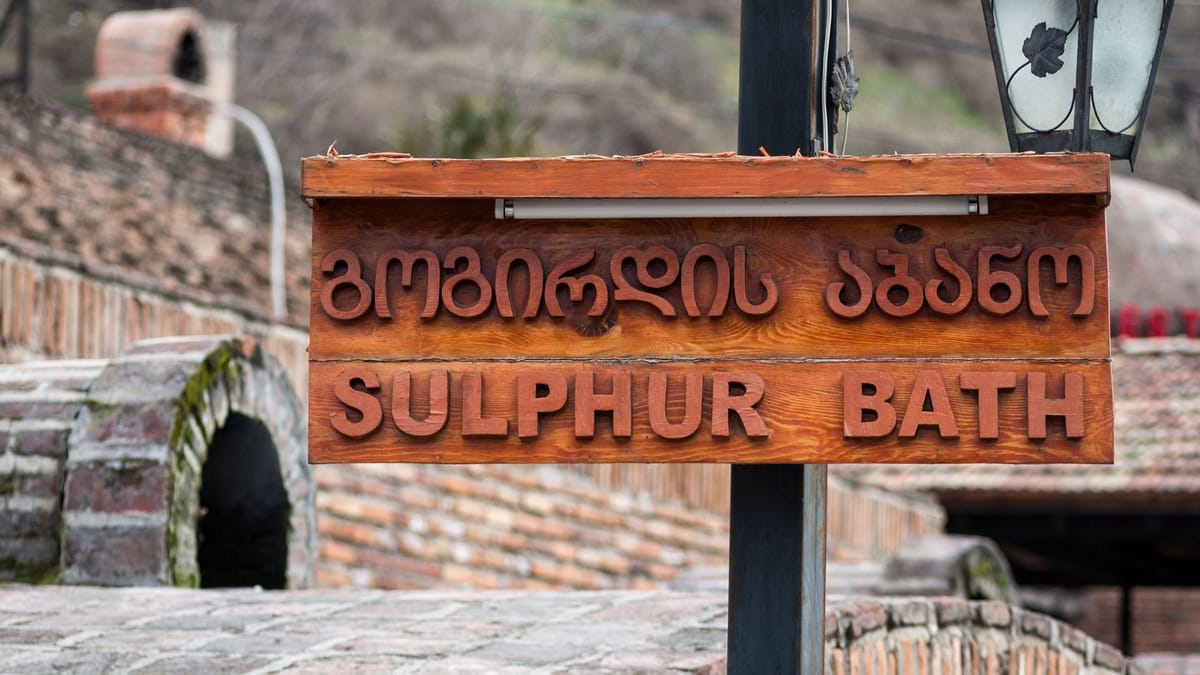
The brick domes of the sulphur bath district are the reason the city exists, according to the founding legend, and the water still arrives naturally hot and strongly sulphurous. What visitors should calibrate is the register. These are functional bathhouses with tiled rooms, plunge pools and an optional and vigorous scrub from an attendant, not wellness resorts.
Private rooms are rented by the hour, and prices vary sharply between establishments on the same street, from the very plain to the ornate. The public sections in some houses are cheaper still and are single sex. Towels and slippers are usually extra, and the scrub is negotiated separately at the door.
The smell lingers on skin and hair for hours afterwards, which is a reasonable trade and worth planning around if there is a restaurant booking that evening.
Sololaki and Chugureti are where the architecture is quietly collapsing
- Sololaki’s nineteenth-century apartment buildings hide painted stairwells and stained-glass landings behind unmarked doors, many of them structurally unsound and unfunded.
- Chugureti, across the river, carries the wooden-balconied houses that appear on every Tbilisi postcard, in visibly worse repair than the restored strip along Chardin Street.
- The Fabrika complex in Chugureti, a converted Soviet sewing factory, has become the anchor for the city’s bar and studio scene without being sanitised out of recognition.
- Betlemi Street and the lanes climbing towards Narikala are the least altered part of the old town, and the only part where the mixture of church, mosque and synagogue within a few hundred metres is immediately obvious.
- Entire blocks are being demolished for new development, and the campaign to document what remains is run largely by volunteers rather than by the state.
Supra is a schedule, not a meal
A Georgian supra is a structured feast governed by a tamada, the toastmaster, who directs a sequence of toasts through the evening. Dishes arrive simultaneously and are stacked on top of one another rather than cleared. Visitors invited to one should understand that leaving early is a real breach and that the toasts are not optional decoration.
Georgian wine is made in qvevri, buried clay vessels, in a method with an eight-thousand-year documented lineage that UNESCO recognises as intangible heritage. The amber or orange wines produced this way are the country’s genuine contribution to world drinking, and they are poured casually in Tbilisi at prices that would be impossible anywhere in western Europe.
The food is more varied than the khinkali dumplings and khachapuri cheese breads that dominate foreign menus. Regional cooking from Samegrelo, Adjara and the mountain provinces differs considerably, and the restaurants doing the interesting work are increasingly found away from the old town’s tourist strip.
Sources: UK FCDO travel advice: Georgia safety and security · OSAC: Georgia, one year of protests over EU accession · Sakhva Travel: Tbilisi cable car price, hours and route · Wander-Lush: Georgia travel guide